
06· Sexual health
Works on desire, not blood flow.
Bremelanotide, better known as PT-141, is a melanocortin peptide studied for low sexual desire and arousal: it works on a signal in the brain rather than on the blood vessels. The injection is FDA-approved for premenopausal women with hypoactive sexual desire disorder; the nasal spray is compounded and off-label, and a clinician checks your blood pressure and history first, because sometimes the answer is no.
Prescription required. A licensed provider decides whether treatment is appropriate.
At a glance
What it is
A peptide that works upstream.
Bremelanotide is a synthetic ring peptide modelled on alpha-melanocyte-stimulating hormone and an analogue of Melanotan II, a tanning peptide that was itself tested for erectile dysfunction. It activates melanocortin receptors, chiefly MC4R in the hypothalamus, where sexual desire and arousal are set; it does not act on the blood vessels of the penis the way sildenafil or tadalafil do. Palatin studied it as a nasal spray in men and women in the early 2000s, ended that programme in 2008 after the FDA raised questions about rises in blood pressure, and brought it back as an injection.
That injection, Vyleesi, 1.75 mg under the skin, was approved on 21 June 2019 for acquired, generalized hypoactive sexual desire disorder in premenopausal women. It is not approved for men, for postmenopausal women, or to enhance sexual performance, and the nasal spray is not FDA-approved for anyone. If a clinician prescribes it, a state-licensed 503A compounding pharmacy prepares it in your name and ships it sealed. Compounded medicines are not reviewed by the FDA for safety, effectiveness or quality.
Not FDA-approved as a spray. The injection is, for premenopausal women; in men the evidence is old and thin. We say so.
How it works
How it works, in three moves.
A melanocortin agonist: it speaks to the receptors the brain uses for desire, and leaves the blood vessels alone.
Activates melanocortin receptors
Bremelanotide binds the MC4R and MC3R receptors, the same receptors the brain's own alpha-MSH uses. It also touches MC1R in the skin, which is where the pigment effect comes from.
A signal in the hypothalamus
MC4R sits densely in the medial preoptic area of the hypothalamus. In animal studies, activating it there releases dopamine, the neurotransmitter of wanting; the drug works upstream, on desire and arousal, not on the erection itself.
Desire and arousal, if the signal lands
For some people that shows as more interest and readiness within an hour or two; for others nothing changes. It still needs sexual context: it is not a switch, and it does not fix a vascular cause of erectile dysfunction.
One metered dose
A fine mist, as needed.
Forty-five minutes to two hours before. One dose in twenty-four hours, no more than eight a month, and a decision at eight weeks.
Who it is for
Who it is considered for.
A clinician decides on your blood pressure, your history and the reason desire is low. These are the situations it is usually considered for.
- 01
Low sexual desire that causes distress
Acquired, generalized hypoactive sexual desire disorder: desire that used to be there, has fallen, and now causes distress, in a premenopausal woman, once other explanations have been considered. This is the population the injection was approved for; the spray is off-label even here.
- 02
Men whose difficulty is desire or arousal rather than blood flow
Bremelanotide was studied in men with mild-to-moderate erectile dysfunction, including men who did not respond to sildenafil. That evidence is about twenty years old and limited, and use in men is off-label; a clinician decides whether it is a reasonable question for you.
- 03
When a PDE5 inhibitor is the wrong tool, or not enough
Sildenafil and tadalafil need arousal to work and do nothing for desire. One small crossover study gave a low nasal dose alongside 25 mg sildenafil and measured more erectile activity than sildenafil alone; combining the two is a clinician's decision, not a default.
Not the right fit when
- Uncontrolled high blood pressure, or known cardiovascular disease: the label's contraindications.
- High cardiovascular risk even with controlled blood pressure: the label says not recommended.
- Pregnancy, trying to conceive, or breastfeeding: pregnancy is excluded and reliable contraception expected.
- Anyone under 18; postmenopausal women are outside the approved population.
- Oral naltrexone for alcohol or opioid dependence: bremelanotide can cut its absorption, with serious consequences.
- Severe kidney impairment or severe liver impairment: the label advises caution in one and has no data in the other.
- Low desire better explained by something else: depression, a medicine such as an SSRI or an opioid, low testosterone, pain, or a relationship in difficulty. Those are addressed first.
Your clinician goes through this with you on the visit. Some histories rule it out; if yours does, you are told plainly and offered what they would look at instead.
The visit
What your clinician looks at.
A real visit by video, usually within minutes of starting. They ask, you ask, and they decide whether treatment is appropriate. Sometimes the answer is no.
Prescription required. A licensed provider decides whether treatment is appropriate.
- 01
Blood pressure, twice
Two readings on separate occasions, plus heart rate, and a cardiovascular history: angina, heart attack, arrhythmia, stroke, heart failure, and the risk factors behind them. Uncontrolled hypertension or known cardiovascular disease ends the conversation.
- 02
Medicines and the rest of your health
PDE5 inhibitors, naltrexone, oral medicines that need steady levels, antidepressants and opioids that lower desire; kidney and liver function; for women who could conceive, pregnancy excluded and contraception in place.
- 03
The reason desire is low
A screen for hypoactive sexual desire disorder, and for depression, relationship difficulty, pain or an arousal problem. In women, premenopausal status. In men, two early-morning testosterone tests where low desire could be hormonal, and an honest look at whether the real problem is erection rather than desire.
How it is taken
As needed, with ceilings.
- 01
One dose, in advance
Used as needed, 45 minutes to 2 hours before anticipated sexual activity, the window used in the nasal-spray trials. The approved injection is taken at least 45 minutes before. The dose on your prescription is set by your clinician and the pharmacy's formulation; the nasal doses studied in the trials were mostly 7.5 to 20 mg, and the spray is not interchangeable with the injection.
- 02
One dose in 24 hours, no more than eight a month
The label's ceiling, and ours for the spray. Doses 24 hours apart did not add to the blood-pressure effect in the trials; daily dosing is where skin darkening appeared.
- 03
Eight weeks, then a decision
If desire has not changed after about eight weeks of use, the label says stop, and so do we. Nausea is commonest on the first dose and eases by the second for most people; an anti-nausea tablet was needed by 13% of women in the trials, though taking ondansetron beforehand did not prevent it.
What to expect
What happens, and when.
- 01
The first hour or two
A nasal dose reached peak blood levels at about 30 minutes in the men's studies, and where an erection occurred it began at about 30 minutes; the injection peaks at about an hour. The half-life is about 2 to 3 hours, so the window is a few hours, not a day.
- 02
What it does, and does not
It is a signal about desire and arousal, not a hydraulic one. It does not produce an erection without sexual context, and it does nothing for a vascular cause of erectile dysfunction. In women it raised desire scores modestly against placebo; the number of satisfying sexual events did not change.
- 03
Some respond, some do not
In the women's trials the average gain was small and 18% stopped for side effects. In the largest men's trial, a third of sildenafil non-responders responded against about one in twelve on placebo, in a paper now under an expression of concern. Not responding is information; after eight weeks without change, we stop.
The spray
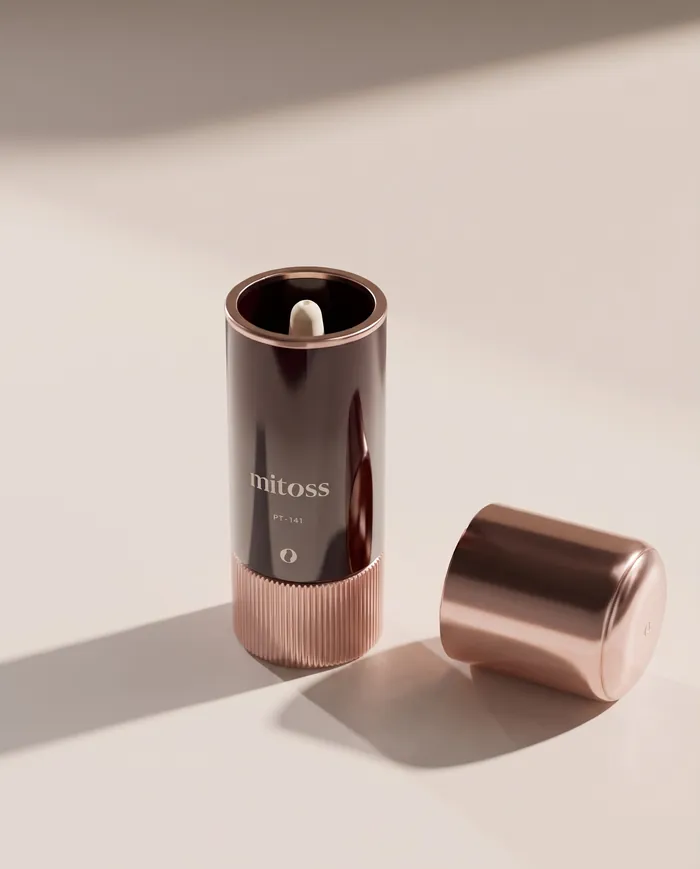
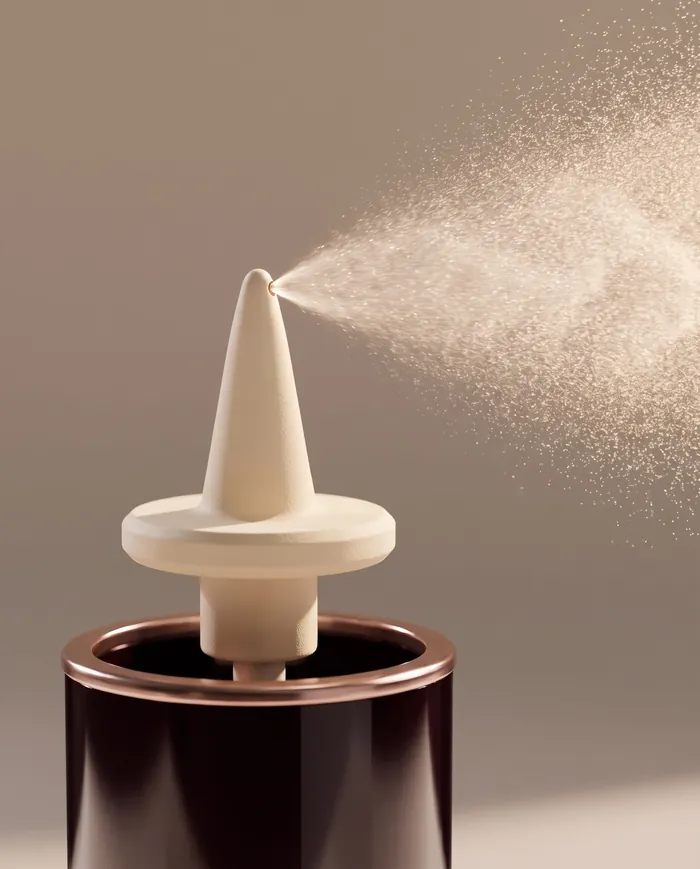
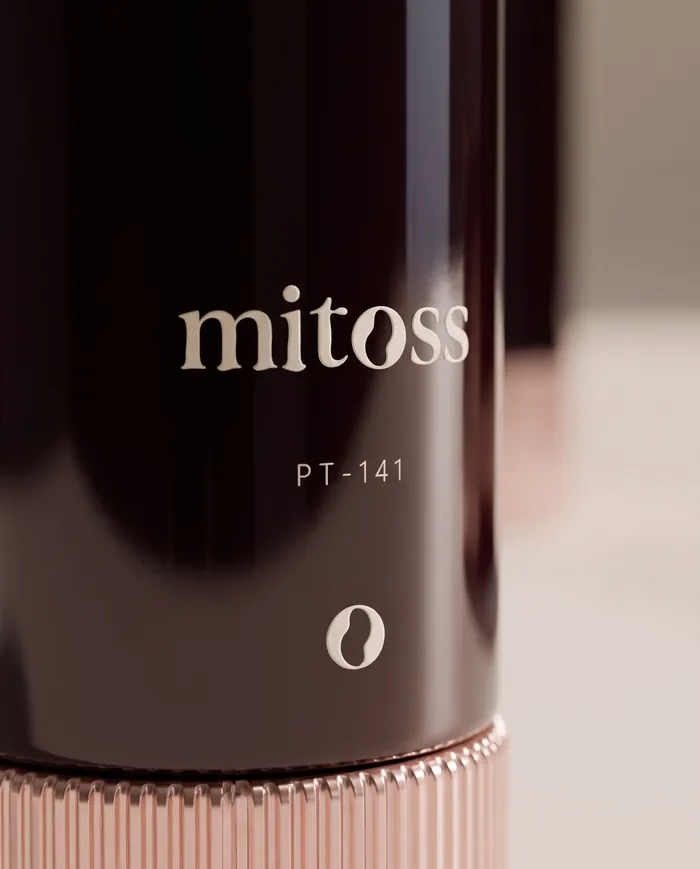
The spray, up close.
A metered nasal spray with a cap that closes: nothing to inject, nothing to measure, and the dose set by your clinician and the pharmacy.
Side effects, plainly
What it can feel like.
Nausea on the first dose is the common one and eases for most people by the second; your clinician tells you what to watch for.
In 40% of women on the injection against 1.3% on placebo: 21% after the first dose, about 3% on later doses, and 8% stopped because of it. Flushing and nausea were also the commonest effects in the men's nasal studies.
Flushing in about 20% and headache in about 11% on the injection, usually mild and short-lived.
Systolic up by as much as 6 mmHg and diastolic by 3 mmHg, peaking 2 to 4 hours after a dose, with heart rate down by up to 5 beats a minute, back to baseline within about 12 hours. Small for most people; it is why the drug is contraindicated in uncontrolled hypertension and cardiovascular disease, and why the FDA questioned the earlier nasal form.
Focal hyperpigmentation of the face, gums or breasts in about 1% at up to 8 doses a month, but in 38% after 8 consecutive daily doses; more likely in darker skin and not always reversible. The monthly ceiling exists for this.
Any nasal spray can irritate: congestion, a runny or sore nose, an unpleasant taste after a dose. Nasal congestion was reported by about 2% even on the injection. Tell your clinician if it persists.
Each in a few percent on the injection: vomiting about 5%, fatigue and hot flush about 3%, paresthesia about 3%, dizziness about 2%.
Bremelanotide slows the stomach, so an oral medicine taken near a dose may be absorbed less, including antibiotics and painkillers such as indomethacin; it markedly lowers exposure to oral naltrexone, which is avoided. One case of acute hepatitis in the extension study could not be ruled out as drug-related.
This is not a complete list. Your clinician goes through the risks that apply to you before anything is prescribed, and is a message away if something does not feel right.
The evidence
What the research actually shows.
- In the two 24-week phase 3 RECONNECT trials (1,267 premenopausal women with hypoactive sexual desire disorder), bremelanotide 1.75 mg under the skin raised the FSFI desire score by 0.5 to 0.6 points against 0.2 on placebo (scale 1.2 to 6) and lowered distress about low desire by 0.7 against 0.4 points (scale 0 to 4); satisfying sexual events did not differ from placebo, 39 to 40% of women on the drug left early against 13 to 25% on placebo, and 18% stopped for adverse reactions against 2%.13
- The men's evidence is older and smaller: in Palatin's early intranasal studies, erections measured by RigiScan were significant against placebo at nasal doses above 7 mg, with the first erection at about 30 minutes, peak levels at 30 minutes and a half-life of 1.9 to 2.1 hours; in a 2008 trial of 342 men who had not responded to sildenafil, 10 mg intranasal bremelanotide 45 minutes to 2 hours before sex produced a response in 33.5% against 8.5% on placebo, a paper the Journal of Urology placed under an expression of concern in 2023.71011
- On the approved injection, systolic blood pressure rises by up to 6 mmHg and diastolic by up to 3 mmHg, peaking 2 to 4 hours after a dose while heart rate falls by up to 5 beats a minute; nausea affected 40% of women against 1.3% on placebo, flushing 20.3% and headache 11.3%, and focal hyperpigmentation 1% at up to 8 doses a month but 38% after 8 consecutive daily doses.156
- Palatin ended the intranasal programme in May 2008 after the FDA raised questions about blood-pressure increases with the nasal form, and the drug came back as an injection; a 2026 Sexual Medicine Reviews narrative review of 76 studies counts bremelanotide among the two most clinically established peptides in sexual medicine while noting that peptide safety data are limited by short follow-up and small samples, and an independent re-analysis of the RECONNECT data found discontinuation for adverse events about 12 times more likely on the drug than on placebo (number needed to harm 6).12131820
Compounded medications are prepared by US state-licensed 503A pharmacies for individual patients on a prescription; they are not FDA-approved. Availability varies by state.
Sources
- 1VYLEESI (bremelanotide injection), for subcutaneous use — prescribing information, Cosette Pharmaceuticals; DailyMed (label revised 11/2025; sections 2, 4, 5.1-5.3, 6.1, 7, 8, 12.3, 14)
- 3Kingsberg SA et al. Bremelanotide for the Treatment of Hypoactive Sexual Desire Disorder: Two Randomized Phase 3 Trials (RECONNECT 301 and 302). Obstet Gynecol 2019;134:899-908
- 5Clayton AH et al. Safety Profile of Bremelanotide Across the Clinical Development Program (3,500 subjects, 43 studies). J Womens Health 2022;31:171-182
- 6White WB et al. Usefulness of ambulatory blood pressure monitoring to assess the melanocortin receptor agonist bremelanotide. J Hypertens 2017;35:761-768
- 7Diamond LE et al. Double-blind, placebo-controlled evaluation of the safety, pharmacokinetic properties and pharmacodynamic effects of intranasal PT-141 in healthy males and patients with mild-to-moderate erectile dysfunction. Int J Impot Res 2004;16:51-59
- 10Safarinejad MR, Hosseini SY. Salvage of sildenafil failures with bremelanotide: a randomized, double-blind, placebo controlled study (342 men, 10 mg intranasal). J Urol 2008;179:1066-1071
- 11Journal of Urology. Expression of Concern: Salvage of Sildenafil Failures With Bremelanotide (Safarinejad & Hosseini 2008). J Urol 2023; doi 10.1097/JU.0000000000003117
- 12Drug Store News. Palatin to cut staff, cancel work on ED drug (bremelanotide nasal spray; FDA questions about blood pressure spikes; King Pharmaceuticals exits), May 15, 2008
- 13Gelman F, Atrio J. Flibanserin for hypoactive sexual desire disorder: place in therapy ('an earlier intranasal formulation caused concerning elevated blood pressures'). Ther Adv Chronic Dis 2017;8:16-25
- 18Spielmans GI. Re-Analyzing Phase III Bremelanotide Trials for 'Hypoactive Sexual Desire Disorder' in Women (adverse-event discontinuation OR 11.98, NNH 6). J Sex Res 2021;58:1085-1105
- 20Vasylieva V et al. Peptides in urology and sexual medicine: clinical effectiveness, dosing, indications, and safety: a narrative review (76 studies). Sex Med Rev 2026;14(4)
Bremelanotide is FDA-approved only as Vyleesi, a 1.75 mg subcutaneous autoinjector, for premenopausal women with acquired, generalized hypoactive sexual desire disorder (approved 21 June 2019); the nasal spray is not FDA-approved for any use, in men or women, and if a clinician prescribes it off-label it is prepared by a licensed 503A compounding pharmacy, and compounded drugs are not reviewed by the FDA for safety, effectiveness or quality.
Questions
Asked often.
Anything about your own health is answered by a licensed clinician on a visit, not here.
Is PT-141 FDA-approved?
The injection is, for one use: Vyleesi, 1.75 mg under the skin, for premenopausal women with acquired, generalized hypoactive sexual desire disorder, approved on 21 June 2019. The nasal spray is not FDA-approved for anyone. Palatin studied a nasal form in men and women and stopped it in 2008 after the FDA raised concerns about blood pressure; the drug returned as an injection. A compounded spray is prescribed off-label, and the FDA has not reviewed the product you receive.
How is it different from Viagra or Cialis?
Sildenafil and tadalafil act on the blood vessels of the penis: they help an erection happen once you are aroused and do nothing for desire. Bremelanotide acts on melanocortin receptors in the brain, on the desire and arousal signal itself. In men it was studied for erections too, and one small trial combined a low nasal dose with sildenafil. It is not a substitute for a PDE5 inhibitor where the cause is vascular, and nitrates are not the issue they are with PDE5 inhibitors; blood pressure and heart disease are.
Does it work for men?
The honest answer: the evidence in men is older and thin. Palatin's early studies measured erections in men with mild-to-moderate erectile dysfunction at nasal doses above 7 mg, and a 2008 trial in 342 sildenafil non-responders reported a response in a third against 8.5% on placebo, but that paper is now under an expression of concern and no men's trial has been run since the programme ended. No regulator has approved bremelanotide for men. If a clinician prescribes it, it is a considered off-label decision with an eight-week stop rule.
Can women use it?
Women are the population it was approved for, as an injection: premenopausal, with acquired, generalized hypoactive sexual desire disorder. In the RECONNECT trials the average gain in desire was small, satisfying sexual events did not change, and 18% stopped for side effects. The spray is off-label even for women. Postmenopausal women were not studied in the registration trials, and the label says it is not indicated for them.
Why the nose and not a shot?
Preference, mostly. Peak levels come about 30 minutes after a nasal dose and about an hour after the injection, and in one study a 20 mg nasal dose gave exposure roughly one to two times the 1.75 mg injection. The trade-offs: the nasal form is the one the FDA questioned over blood pressure, dosing is less precise than an autoinjector, and it is compounded rather than approved. If a clinician thinks the approved injection is the better fit, they will say so.
Why might the answer be no?
Because your blood pressure is not controlled, you have heart disease or high cardiovascular risk, you are pregnant or could be, you take oral naltrexone, your low desire is better explained by depression, a medicine, low testosterone or a relationship in difficulty, or because your real problem is erection with a vascular cause, where a PDE5 inhibitor is the right first step. Sometimes the answer is no, and we tell you why.
Not the right fit? Other directions.
If your erections are the problem and the cause is vascular, diabetes, blood pressure or the arteries themselves, a PDE5 inhibitor with a clinician is the right first step; bremelanotide is not a substitute for it. If desire is low and your morning testosterone is low on two tests, that is a conversation about the hormone axis, on our testosterone page, not about a desire peptide. If the loss of desire tracks a relationship, stress, depression or a medicine such as an SSRI, therapy and a medication review come first and often settle it; a drug added on top of an unaddressed cause rarely helps. If you are a woman past menopause, you are outside the population bremelanotide was approved for, and the better conversation is about menopausal hormone therapy or, where desire is the specific concern, transdermal testosterone under a specialist.







Modern medicine, made personal.
Prescription required. A licensed provider decides whether treatment is appropriate.